Once I was demobilised from the British Army, I found myself, as many other men must have done, at a loss. So I got myself to Oxford, that celebrated seat of learning.
It happened that I was reading Thomas Hardy’s novel, Jude the Obscure. I felt myself as ignorant as Jude, and as unwanted as he, in that illustrious and learned town.
Writing is an activity one can pursue in solitude. Nor was I a tyro as a writer. I had been writing even as a child.
A little success came my way, but an intense feeling of being unwanted, originating from my birth, never left me. I covered it with humour. Humour indeed, is a great defence; to hear people laughing is one way to believing people may actually like you. [Unless, that is, they are laughing at you…]
Of course one reads obsessively. I came across a book with a title I could not resist: The Dynamics of Creativity. It proved wonderfully accessible, explaining the necessities for self-expression, and the need and fortitude required for self-expression.
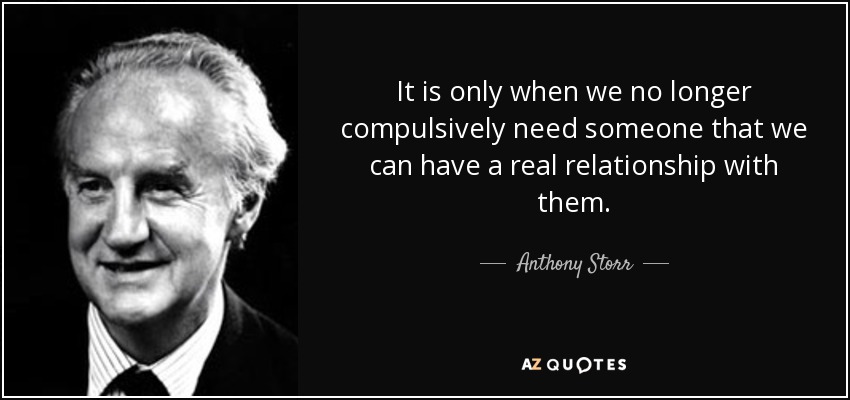
The author of Dynamics of Creativity was Anthony Storr. He lived in Oxford, where he held various distinguished posts. I met him at some meeting or other, and we got talking.
We formed a friendship. I loved the man, with his sly humour, and I soon got to know his wife, Catherine. Catherine too became a friend, and gave me a copy of her life of Wilkie Collins, The King of Inventors.
I discovered that Anthony read all manner of strange books, as did I. Kafka was then high on my list, with P.D.Ouspensky [The Strange Life of Ivan Osokin etc]. We were perhaps a type of escapologist.
Frequently I would dine with Anthony and Catherine at their house in North Oxford. I thought it a great privilege. They began by looking rather gloomy, but then we got talking over a glass of wine – was this where I picked up the habit? – and in no time we were shaking with laughter across the table.
I must not give the impression I at any time, in any way, regarded myself as on an equal footing with Anthony, although that was how he treated me. Anthony was one of the country’s most distinguished psychiatrists. He dressed elegantly; possibly it served as a partial cure for my inelegance.
One of Anthony’s more popular books was Churchill’s Black Dog, in which he explores the depression which often overcame Winston Churchill, whose mother had had no time for him. Anthony also suffered from that same midnight hound. We found we had much in common.
Here is a small part of what Anthony has to say on the matter:
“People who suffer from depression are always asking themselves why anyone should love them. They often feel entitled to respect, to awe, or to admiration; but as for love, that is too much to expect. Many depressives only feel loveable in so far as they have some achievement to their credit, or have given another person so much that they feel entitled to a return.”
Is any escape possible? Well, there is fortitude. Anthony says of Jung that ‘He did not believe that the spiritual journey which he called individuation should be undertaken by everyone.’
For some, however, that arduous journey appears compulsory.
In the late 1970’s, independent paperback firms existed; the electronic age had yet fully dawned on publishers. I was eager to introduce to a general public forgotten or neglected novels which might come under the general heading of fantasy or science fiction [a category heading for which I had no great affection]. Among such titles was Joseph O’Neill’s Land Under England, first published in 1935.
It is a fine compelling story and it seemed likely to hold an appeal for Anthony. I posted a copy to him on a Monday and went round to see him on the Thursday, to ask him if he would care to write an introduction for the forthcoming New English Library ‘Master SF Series’.
To my astonishment, Anthony had so liked the argument of the novel that he had already written an introduction! He speaks of the central character of the novel, who has discovered his father to be a brute living in darkness, as holding humanistic values. ‘It is only,’ says Anthony, ‘when a man can stand his own isolation, when he refuses to let himself be swamped by either the group or by a dominant personality like the father, that he can attain full stature.”
The blessed quality of surprise!
The Sunday Review, published by The Independent, carried a large photo of Anthony and me in its issue for 22nd October 1995. Anthony looks just as I found him, genial and clever. In the text, he speaks so affectionately of me; it’s touching. And extraordinary.
He claims that what he calls my ‘interest in odd mental experiences’ is a strong link between us’. Indeed I trust it was as he says.
But later on, dear friend Anthony fell ill . He died in 2001. Perhaps he had always been fragile; a quality that made him strong in friendship.
I miss him and hold him always in my affections. Not all the intelligent are kind, or all the kind intelligent. As Anthony Storr was.